 In solid roofs, the watertight coating is not separated from the thermal insulation by a ventilated air gap and as a result, the design requires solving the problem of water vapor flow from the side of the heated interior.
Full roofs … read on
In solid roofs, the watertight coating is not separated from the thermal insulation by a ventilated air gap and as a result, the design requires solving the problem of water vapor flow from the side of the heated interior.
Full roofs … read on
 The contact of the outer wall with the roof has a great impact on the architectural expression of the whole building. Depending on the type of roof, its edging may have different heights:
• In full flat roofs, height from … read on
 At the outset, it should be noted, that it is difficult to specify technical recommendations for the conservation of monuments of construction and architecture with a brick structure, because conservation sciences are subject to continuous development, the criteria including … read on
 After the Second World War, the issues related to the protection of monuments became particularly acute on an international scale.. In many countries, the resources of monuments have decreased; therefore at the initiative of UNESCO was taken … read on
 Of the many other researchers and theorists, the most modern views were proclaimed by Gustavo Giovannoni. (1873-—1948). This outstanding engineer, the scientist and conservator of monuments developed in his treatise on Boito's views and theories as well … read on
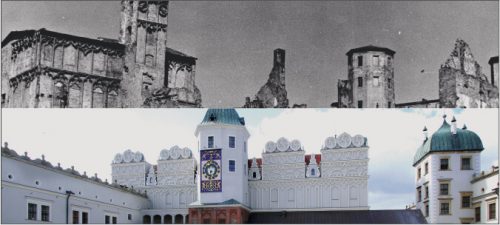 Maintenance issue, Repair, the restoration or reconstruction of architectural divisions is probably so old, like construction technology. From many sources, as well as on the basis of research on the monuments themselves, results, that both … read on
 Traditional floor screed is a uniform layer, which during laying has a loose consistency, plastic or liquid, and after a certain period of time it hardens. Such a screed performs the function of a jointless floor underlay, less often … read on
 So-called. floating floor is the most commonly used solution when finishing a raw concrete ceiling. Floating floor is a concrete screed about a thickness of 5 Cm, made on insulating material – for example. on decomposed on … read on
 Dense-ribbed wooden ceilings are ceilings made of wooden beams (called ribs) with a short wheelbase, thanks to which they carry light loads and can have small dimensions. They are most often made of boards … read on
 POROTHERM ceilings are made of ceramic blocks, which is based on ceramic-reinforced concrete ceiling beams. The upper level of the masonry, on which the ceiling is to be laid should be leveled with a thin layer on the right … read on